Breakfast Quiche Masterpiece: Chef’s Guide to Perfect Quiches Every Time
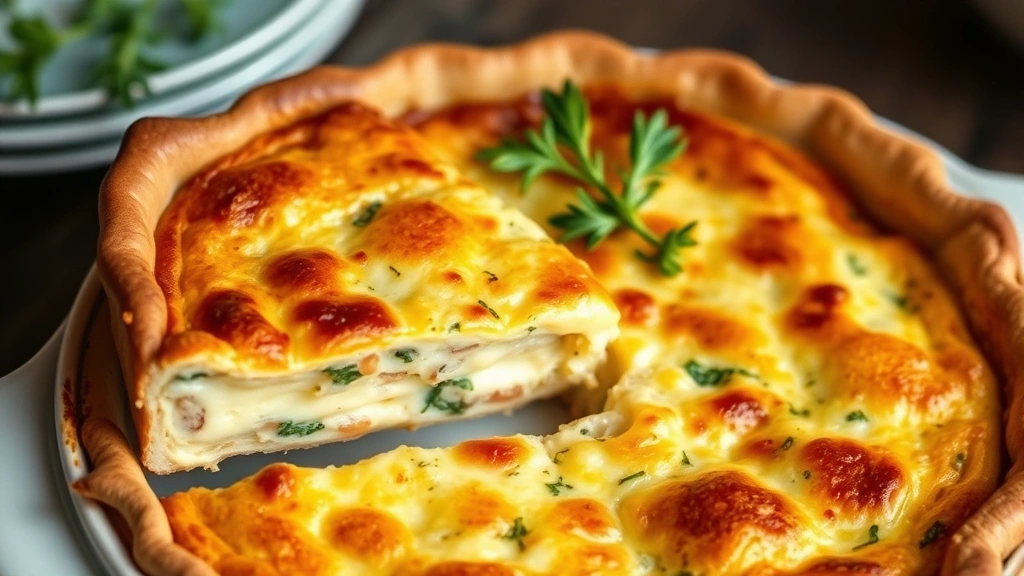
A perfectly baked breakfast quiche is the hallmark of culinary confidence. This elegant dish transforms simple ingredients—eggs, cream, cheese, and seasonal vegetables—into a showstopper that impresses at any brunch table. Whether you’re preparing breakfast for your family or hosting a dinner party, mastering the art of quiche-making elevates your cooking repertoire significantly.
The beauty of a breakfast quiche recipe lies in its versatility and reliability. Once you understand the fundamental techniques and proportions, you can customize virtually every element to suit your preferences. From classic combinations to adventurous flavor pairings, quiches offer endless possibilities for creative expression in the kitchen. This comprehensive guide walks you through every step, from selecting ingredients to achieving that perfect creamy custard with a golden, crispy crust.
Understanding Quiche Fundamentals
A breakfast quiche is fundamentally a savory custard tart. The traditional French preparation consists of three essential components: a pastry shell, a filling of vegetables or meat, and a custard mixture of eggs and cream. Understanding how these elements interact creates the foundation for consistent success.
The custard ratio is critical. Professional chefs follow the classic formula of one egg per quarter cup of liquid (cream and/or milk). This proportion ensures a set custard that remains creamy rather than rubbery. Too many eggs produce a dense, overly firm texture; too few result in a quiche that never sets properly and remains soupy in the center.
Temperature control throughout the cooking process determines whether your quiche achieves that ideal texture—custardy center with a stable structure. Starting with room-temperature ingredients and managing oven temperature prevents the edges from overcooking while the center remains underbaked. Many home cooks struggle with this balance, but understanding the science behind the process makes it manageable.
Selecting Your Pie Crust
Your crust foundation deserves careful consideration. You have three primary options: store-bought frozen, refrigerated pre-made, or homemade from scratch. Each approach offers distinct advantages depending on your skill level and time availability.
Store-bought frozen crusts provide convenience and surprisingly consistent results. They’re fully blind-baked, meaning you can fill them directly without pre-baking. This saves significant time while eliminating concerns about soggy bottoms—a common quiche pitfall.
Refrigerated crusts from the dairy section offer a middle ground. These unbaked shells require partial blind-baking before filling. Blind-baking means pre-baking the empty crust, usually with pie weights or dried beans, for 8-10 minutes at 375°F (190°C). This technique seals the surface and prevents moisture absorption from the custard filling.
Homemade crusts showcase your skills but demand precision. The key is handling the dough minimally and keeping all ingredients cold. Serious Eats offers comprehensive guidance on developing flaky, tender pastry. Your homemade crust must also be blind-baked before adding the filling.
Regardless of your choice, ensure your crust reaches room temperature before adding the hot custard filling. Cold crust meeting hot filling causes uneven baking and potential cracking.
Mastering the Custard Base
The custard foundation determines your quiche’s success. This simple mixture of eggs, cream, milk, salt, and pepper transforms humble ingredients into silky richness. The technique matters more than ingredient cost.
Egg Selection: Large eggs work best for consistency. Room-temperature eggs incorporate more smoothly into the custard, creating a homogeneous mixture without lumps.
The Cream-to-Milk Ratio: Using 100% heavy cream produces an extraordinarily rich quiche, while all milk yields a lighter version. Most professional chefs use a 1:1 ratio of heavy cream to whole milk, balancing richness with delicate texture. For a vegetarian breakfast quiche recipe, this ratio remains consistent.
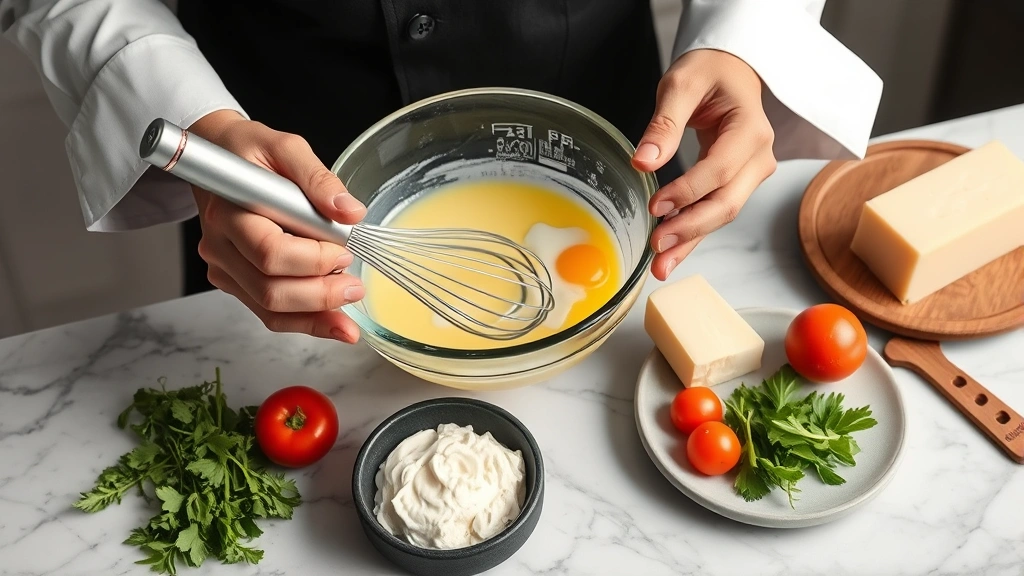
Whisking Technique: Whisk eggs thoroughly before adding cream. This aerates the eggs slightly, contributing to a fluffier final texture. Add cream gradually while whisking constantly. Strain the custard through fine-mesh sieve before pouring into the crust. This removes any egg white strands and ensures absolute smoothness.
Seasoning Precision: Season the custard base itself, not just the fillings. Use kosher salt (easier to control than table salt) and freshly ground black pepper. Nutmeg—just a whisper—adds sophisticated depth without announcing itself. Many classical French preparations include a pinch of cayenne pepper for subtle warmth.
Prepare your custard mixture just before baking. Letting it sit allows air bubbles to rise to the surface, which you can skim off with a spoon before baking. These bubbles create holes in your finished quiche.
Ingredient Selection and Preparation
The filling ingredients make your breakfast quiche recipe distinctive. Understanding preparation methods ensures even cooking and maximum flavor.
Cheese Selection: Use cheeses that melt smoothly and won’t separate. Gruyère remains the classic choice—nutty, complex, and melting beautifully. Cheddar, fontina, and Swiss work excellently. Avoid fresh cheeses like feta or goat cheese unless you enjoy a grainy texture. Shred cheese yourself rather than using pre-shredded; commercial versions contain anti-caking agents that prevent smooth melting. Distribute cheese evenly throughout the quiche for consistent flavor in every slice.
Vegetable Preparation: Raw vegetables release moisture during baking, potentially making your quiche watery. Pre-cook vegetables until nearly tender. Sauté mushrooms and onions until their liquid evaporates. Blanch broccoli and asparagus briefly, then shock in ice water to stop cooking. Roast bell peppers for deeper flavor. This step takes extra time but transforms your result dramatically.
Meat Considerations: Bacon, sausage, and ham should be cooked completely before adding. Raw meat won’t cook through given your quiche’s brief baking time. Render bacon until crispy, crumble it, and drain on paper towels. Brown sausage thoroughly, breaking it into small pieces. Diced ham works beautifully without pre-cooking.
Herb Integration: Fresh herbs added raw to the custard wilt beautifully. Chives, parsley, and tarragon work wonderfully. Dried herbs concentrate in flavor; use one-third the quantity of fresh. Add herbs directly to the custard mixture for even distribution.
Layer ingredients strategically in your crust. Place heavier items (cheese, meat) on the bottom where they’re less likely to float. Distribute vegetables throughout the middle layers. This organization prevents ingredients from floating to the top and ensures balanced flavor distribution.
Assembly and Baking Techniques
Your preparation culminates in the baking phase. Proper technique here determines whether you achieve a perfectly set custard or encounter common failures.
Assembly Order: Place your blind-baked crust on a baking sheet (this catches any drips and makes handling easier). Add prepared fillings in your planned layers. Pour custard slowly over fillings, filling to within half-inch of the rim. The custard should settle around ingredients without overflowing.
Oven Temperature: Preheat your oven to 375°F (190°C). This temperature allows the custard to set gently without the edges overbaking before the center cooks. Some cooks prefer starting at 425°F (220°C) for 15 minutes to set the edges quickly, then reducing to 350°F (175°C) for the remaining time. This two-temperature method prevents edge shrinkage.
Baking Duration: Most quiches bake 35-45 minutes. The quiche is done when the edges are set and slightly puffed, but the center still jiggles slightly when you gently shake the pan—about a two-inch circle in the very middle should wobble. This residual heat continues cooking the center as it cools, resulting in perfect texture.
The Doneness Test: Insert a knife into the center. It should come out mostly clean with just a tiny bit of custard clinging to it. If liquid custard runs off, bake longer. If the knife comes out completely clean, you’ve likely overcooked it.
Remove your quiche from the oven and let it rest at room temperature for 10 minutes. This stabilizes the custard and makes slicing cleaner. A quiche sliced immediately from the oven tends to break apart; one that’s cooled slightly holds together beautifully.
For a make-ahead breakfast, prepare your quiche the night before, refrigerate it unbaked, and bake it in the morning. Add five minutes to baking time since it starts cold. Many home cooks find this approach perfect for entertaining—everything’s prepared, and you simply pop it in the oven before guests arrive.
Troubleshooting Common Issues
Soggy Bottom Crust: This results from inadequate blind-baking or wet filling ingredients. Always blind-bake unbaked crusts for 8-10 minutes with weights. Pre-cook vegetables thoroughly, draining excess moisture. If using very wet ingredients, pat them dry with paper towels.
Watery Center: Overbaking causes custard to separate, releasing liquid. Remember that the center should still jiggle slightly when done. Alternatively, your custard ratio might be off—too much liquid relative to eggs. Verify you’re using the one-egg-per-quarter-cup formula.
Grainy or Curdled Texture: This indicates overcooked eggs. Lower your oven temperature by 25°F and bake longer. The slower cooking prevents eggs from scrambling. Never bake quiches above 400°F; the high heat scrambles eggs rather than setting custard gently.
Cracked Surface: Cracks form from temperature shock or overbaking. Avoid placing cold quiches directly into a hot oven. Let assembled quiches sit at room temperature for 15 minutes before baking. Don’t overbake; remove when the center still has slight movement.
Ingredients Floating to Top: Ensure your custard mixture is thick enough to suspend ingredients. If ingredients consistently float, your custard ratio has too much liquid. Also, spread fillings in a single layer rather than piling them in one spot, which causes them to float as a mass.
Serving and Storage
A properly baked quiche serves beautifully at multiple temperatures. Serve it warm from the oven, at room temperature for a casual brunch, or chilled straight from the refrigerator. Each temperature offers distinct advantages depending on your occasion.
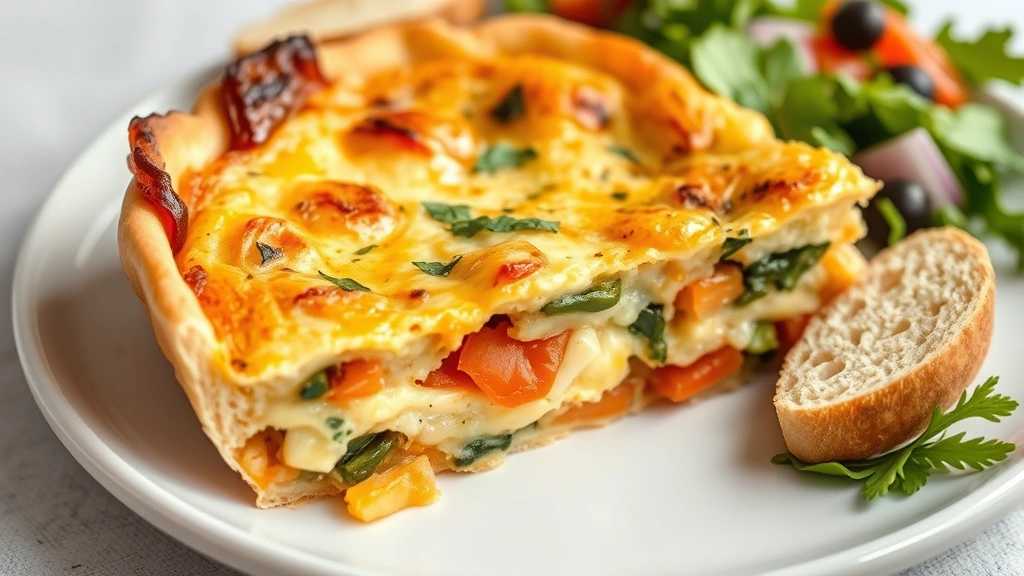
Warm Serving: Ideal for dinner parties and formal brunches. A warm quiche showcases the custardy texture and melted cheese beautifully. Serve with a simple green salad and crusty bread.
Room Temperature Serving: Perfect for casual entertaining. The quiche slices cleanly and the flavors are most pronounced. This temperature works beautifully for picnics and outdoor gatherings.
Chilled Serving: Excellent for breakfast throughout the week. A cold quiche provides satisfying protein and keeps well in the refrigerator. Slice and reheat individual portions, or enjoy cold straight from the fridge.
Storage Guidelines: Refrigerate covered quiches for up to four days. The custard keeps beautifully and flavors often deepen overnight. Freeze unbaked quiches up to two months; bake directly from frozen, adding 10-15 minutes to baking time. Alternatively, freeze baked quiches and reheat gently at 325°F (160°C) until warmed through.
Reheating is simple: cover loosely with foil and warm at 325°F for 15-20 minutes until the interior reaches serving temperature. This gentle approach prevents the custard from overcooking further.
Consider pairing your breakfast quiche with complementary dishes. Healthy dessert recipes make excellent brunch accompaniments. For heartier occasions, steak pasta recipes create impressive dinner-time variations. Even easy Instant Pot recipes can provide quick side dishes alongside your quiche.
For seasonal entertaining, explore fall recipes that incorporate autumn vegetables into your quiche. Spring calls for asparagus and fresh herbs, while summer quiches shine with zucchini, tomatoes, and bell peppers. Philly cheese steak recipe techniques apply beautifully to cheesy quiche variations.
FAQ
Can I make quiche without a crust?
Absolutely. Crustless quiches bake in greased pie dishes and work beautifully. They’re lower in calories and simpler to prepare. Increase baking time by 5-10 minutes since the custard lacks the insulating crust. Some cooks prefer crustless versions for their cleaner presentation and ease of preparation.
What’s the difference between quiche and frittata?
Quiche is baked in a pastry crust with a custard filling (eggs, cream, milk). Frittata skips the crust and uses less liquid, resulting in a denser, more egg-forward texture. Frittatas cook on the stovetop initially, then finish under the broiler. Quiches are purely oven-baked.
Can I use milk instead of cream?
Yes, though the result differs. All milk produces a lighter, less rich quiche. All cream makes it incredibly rich and dense. The traditional 1:1 ratio balances both characteristics beautifully. Experiment with ratios to match your preference.
How do I prevent a watery quiche?
Pre-cook vegetables to remove moisture. Blind-bake your crust. Use the correct custard ratio (one egg per quarter cup liquid). Don’t overbake; remove when the center still jiggles slightly. Pat dry any ingredients that release moisture.
Can I prepare quiche ahead?
Definitely. Assemble it the night before, cover, refrigerate, and bake in the morning. Add five minutes to baking time. You can also freeze unbaked quiches up to two months. Bake from frozen, adding 10-15 minutes to the standard time.
What vegetables work best in quiches?
Mushrooms, onions, bell peppers, broccoli, spinach, asparagus, zucchini, and tomatoes all work beautifully. Pre-cook them to remove excess moisture. Avoid very watery vegetables like cucumbers unless you drain them thoroughly.
How do I know when my quiche is done?
The edges should be set and slightly puffed. The center should jiggle slightly when you gently shake the pan—about a two-inch circle in the very middle. A knife inserted in the center comes out mostly clean with just a tiny bit of custard clinging to it.
Can I freeze baked quiche?
Yes. Cool completely, wrap tightly in plastic wrap and foil, and freeze up to two months. Reheat gently at 325°F (160°C) until warmed through, about 20-30 minutes. This preserves texture and flavor beautifully.


